The ring
The listing says the first hour is a show by former professional wrestlers with a bilingual MC, a chance to try sumo footwork or put on the padded suit, and photo time with the wrestlers. The second hour is a mini chanko nabe hotpot lunch.
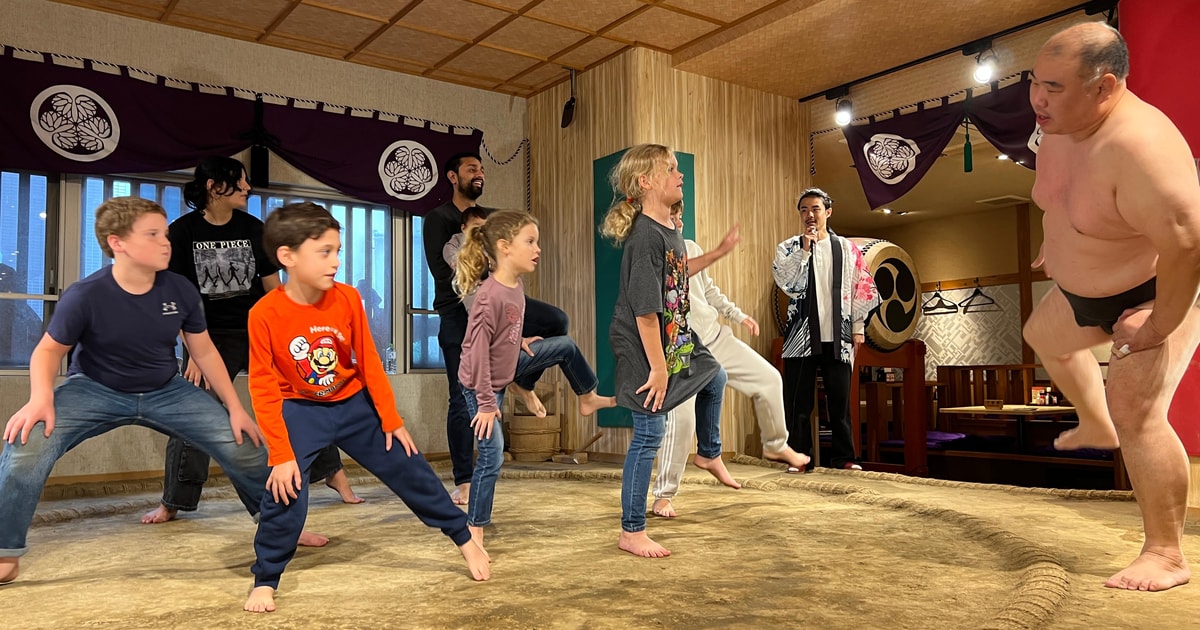
Tokyo Family Sumo · Ryogoku, Tokyo
The Tokyo family sumo workshop is two hours in Ryogoku: a live show by former pros, a go in the padded suit, then a chanko hotpot lunch.
Small daytime groups, so school-holiday dates go first.
The short answer
The Tokyo family sumo workshop is the rare sightseeing hour where children and parents are the ones in the ring: former professional wrestlers put on a live show, guests can try sumo footwork or pull on a padded suit to take on a wrestler, and everyone sits down to a chanko hotpot lunch afterwards. It averages 4.9 out of 5 across 462 guest reviews, it is wheelchair accessible, and the booking is free to cancel until the day before.
The listing says guests can try suri-ashi footwork or wear a padded sumo suit and challenge a wrestler. It is a hands-on session, so the youngest visitors are taking part rather than watching from a seat.
The performers are former professional wrestlers in an intimate venue, and a bilingual MC explains salt-throwing, shiko stomps and techniques as they go. The listing says the instructor speaks English and Japanese.
Hour two is a mini chanko nabe hotpot, the stew Wikipedia describes as what sumo wrestlers eat in large quantities. A family does not need to find a lunch spot afterwards.
Wikipedia names Ryogoku as sumo's heartland, home to most training stables. The meeting point is opposite the Edo-Tokyo Museum, so a museum visit fits the same trip.
The listing includes photo time with the wrestlers, taken with your own cameras. A child in a padded suit facing a wrestler is the picture the trip gets remembered by.
Cancel up to 24 hours before for a refund, and nothing is taken when you reserve, so a school-holiday date can be held before flights and hotels are settled.
Two hours, two halves
The listing says the first hour is a show by former professional wrestlers with a bilingual MC, a chance to try sumo footwork or put on the padded suit, and photo time with the wrestlers. The second hour is a mini chanko nabe hotpot lunch.
Good to know
Wear loose sportswear; shoes come off on the ring. The listing says children aged 6 and over cannot book at the child rate. Vegetarian, vegan, allergy-friendly and pork- and alcohol-free lunches can be requested 48 hours ahead.
Check dates ↗Around the ring
A little background makes the two hours more fun for children and adults. This draws on Wikipedia, Nippon.com and USA Sumo, each named where it is used.
The district
Wikipedia names Ryogoku as sumo's heartland and says most training stables, the heya, are based there. In the Edo period, benefit tournaments were held at Eko-in temple to raise money for temple building. The sport has been part of the district's story for a very long time.
The name
Wikipedia says Ryogoku Bridge was built over the Sumida River in 1659 and that its name means two provinces, because it joined Edo and Shimosa Province. The district took its name from the bridge, a fun fact to tell children as you cross the river.
The ring
Wikipedia describes the sumo ring, the dohyo, as a raised pedestal with a circle of about 4.55 metres across, marked by rice-straw bales. It adds that the ring-entering rituals resemble Shinto shrine practice. You will be on a real ring with your shoes off.
The salt
Wikipedia says wrestlers toss salt onto the ring to cleanse it in a symbolic way, a custom it traces to Shinto. The listing says the bilingual MC explains salt-throwing, so children hear the reason from the wrestlers' own show.
The stomp
Nippon.com says shiko, the leg stomp, descends from a Heian-period rite in which a diviner stomped the earth to drive out evil spirits, and that today it still conveys that the ring is a sacred place. USA Sumo lists it as a basic exercise: raise one leg, hold it briefly, lower it and squat.
The footwork
USA Sumo's training page says suri-ashi means keeping your feet on the ground with knees bent and elbows tucked in, and calls sliding the feet while staying in contact with the ground critical throughout a match. The listing says guests can try it, which makes it the easiest move for a child to copy.
The challenge
Guests can wear a padded sumo suit to challenge a wrestler, the listing says. Wikipedia explains the aim of a real bout: push the opponent out of the ring, or make anything except the feet touch the surface. Bouts usually last only a few seconds.
The lunch
Wikipedia describes chanko nabe as a one-pot stew sumo wrestlers eat by the bowlful, usually built on chicken or dashi broth with vegetables, and says many restaurants serving it are run by retired wrestlers. It adds that the first, Kawasaki Chanko, opened in 1937 in Ryogoku. Chanko served during tournaments is made with chicken only.
The neighbour
Wikipedia says the museum opened in March 1993 as the first museum devoted to Tokyo's history, and lists city models of Edo and Tokyo and a replica of Nihonbashi bridge. Check its own website for current opening days.
The arena
Wikipedia says the present Ryogoku Kokugikan opened in January 1985 next to the Edo-Tokyo Museum and is the venue for Tokyo's three Grand Sumo basho each year (January, May and September). A Sumo Museum is inside the arena, so a family can see where the pros fight after trying the moves themselves.
Drawn from Wikipedia's Ryogoku, Ryogoku Kokugikan, Edo-Tokyo Museum, Sumo and Chanko nabe pages, Nippon.com's piece on sumo's Shinto roots and USA Sumo's training page. The listing's own description is the authority on what the workshop includes.
Reserve
The family workshop is one two-hour session with lunch. Start with a date for it; the tickets below are other family-friendly days in Tokyo.
Two hours in Ryogoku: a live show by former pro wrestlers, a go at sumo footwork or the padded suit, photos with the wrestlers and a mini chanko hotpot lunch.
Entry to the history museum opposite the meeting point, which the listing pairs with a traditional wagashi sweet to taste.
A two-hour guided walk through Tokyo's best-known temple district, easy to pair with the Sumida riverside.
A hands-on class of about 100 minutes where you roll your own sushi, a good second workshop for a family.
An aquarium visit for a family afternoon on the Sumida side of the city.
More family days in Tokyo
Two kinds of sumo outing
Both put you in front of wrestlers. One is a daytime session built around joining in, the other a night out built around watching.
| Family sumo workshop | An evening sumo show | |
|---|---|---|
| What it is | A two-hour workshop with a live show, a go in the ring and lunch | A show to watch, with the format set by each listing |
| Time of day | Daytime sessions | Evenings, as a night out |
| In the ring | Guests can try footwork or wear the padded suit to challenge a wrestler | Check whether the listing lets guests step in |
| Food | A mini chanko nabe lunch is part of the ticket | Varies: check whether a meal or drinks are included |
| Children | Built for families; the child rate stops at age 6 | Check each listing's age rules |
| Diet options | Vegetarian, vegan, allergy-friendly, pork- and alcohol-free on request | Check each listing |
| Guest rating | 4.9 out of 5 across 462 guest reviews | Read the rating on the listing you choose |
| Best for | Families who want to join in and eat together | Adults and older teens after an evening out |
| Who says so | The listing, 25 Nov 2026 | The listing you compare it with |
From the booking page
Taken from the live booking page and its calendar widget on 25 November 2026.
From-price read on 25 November 2026, with the final total for your date shown on the booking page.
Before the big day
Open the calendar and look at school-holiday dates first, since small daytime groups fill early. Nothing is charged to reserve, and a timely cancellation is refunded.
Choose child and adult places carefully: the listing says children aged 6 and over cannot book at the child rate.
Vegetarian, vegan, allergy-friendly and pork- and alcohol-free lunches need a request two days before. The operator cannot guarantee against cross-contamination and holds no Halal certification.
Wear loose sportswear, expect bare feet on the ring, and meet at the seafood izakaya opposite the Edo-Tokyo Museum. Bring your own cameras for the photo time.
Guides
FAQ
Yes. It is a two-hour session in Ryogoku where former professional wrestlers put on a live show, guests can try sumo footwork or wear a padded suit to challenge a wrestler, and a mini chanko nabe lunch follows. It averages 4.9 out of 5 across 462 guest reviews, and the booking is free to cancel until the day before.
The ticket on this page is the family workshop with the live show and lunch. Pick child and adult places in the calendar; the listing says children aged 6 and over cannot book at the child rate, so check the age bands on the booking page before you choose.
The booking calendar lists the dates and sessions with places left. Sessions are in the daytime and groups are small, so school-holiday dates go first. Your confirmation shows the time for the session you choose.
In Ryogoku, Tokyo. The listing gives the meeting point as a seafood izakaya opposite the Edo-Tokyo Museum. Wikipedia says Ryogoku Station is served by JR and Toei lines.
The listing says it lasts 2 hours. Hour one is the live show, the chance to try footwork or the padded suit, and photo time with the wrestlers; hour two is a mini chanko nabe lunch. Transport, alcohol and extra menu items are not included.
The listing says guests can try suri-ashi footwork or wear a padded sumo suit to challenge a wrestler. Shoes come off on the ring, and loose sportswear is recommended. How much each family joins in is up to them on the day.
Loose sportswear. The listing says shoes come off on the ring, so socks or bare feet are the plan.
The listing offers vegetarian, vegan, allergy-friendly and pork- and alcohol-free options if requested 48 hours ahead. The operator holds no Halal certification and cannot guarantee against cross-contamination, so families with strict needs should weigh that.
Per the booking page the experience is wheelchair accessible, with its own entrance. For specific mobility needs, check the booking page before you reserve.
No. The listing says the instructor speaks English and Japanese, and a bilingual MC explains salt-throwing, shiko stomps and techniques during the show.
Yes, the listing includes photo time with the wrestlers, and guests use their own cameras.
It is opposite the meeting point. Wikipedia describes it as Tokyo's history museum, with models of Edo and Tokyo. Check the museum's own website for its opening days and ticket rules, which can change.
No. Wikipedia lists three Grand Sumo basho a year at the Ryogoku Kokugikan, in January, May and September, each lasting 15 days. This workshop is a small daytime session where you take part.
The cancellation terms on this page apply to the family sumo workshop ticket alone; open each other booking page for its own rules.